
Sunday | 23rd November 2025
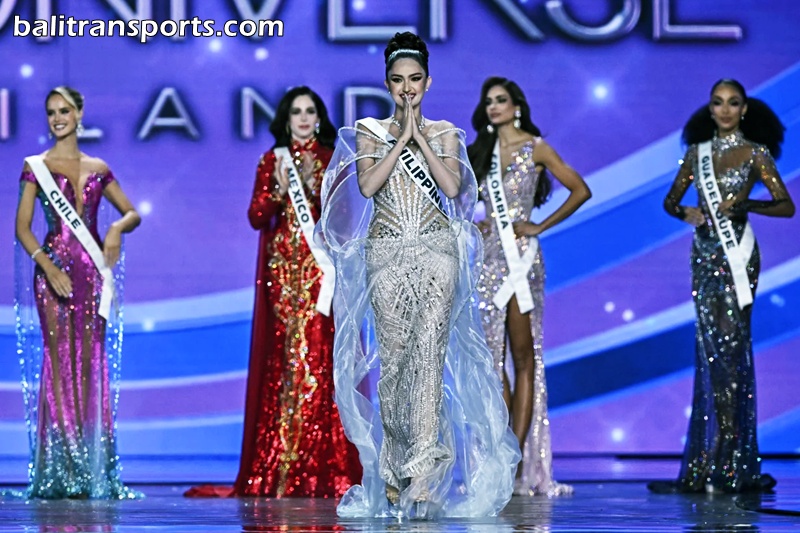
Manila, The Philippines — When Ahtisa Manalo stepped onto the Miss Universe stage for this year’s final, the country stood still. Across living rooms, neighborhood sari-sari stores, malls, cafés and even public plazas, millions of Filipinos tuned in, their eyes glued to the screen as they dissected her walk, her gown, her smile, and every turn she made under the dazzling lights.
For Manalo — the Philippines’ representative at age 28 — the scrutiny is nothing new. She has carried the expectations of a pageant-obsessed nation for years, growing up in a culture where beauty queens are adored almost as passionately as boxing legends and professional basketball stars.
“In the Philippines, people stop and tune in, usually for three things — the three B’s,” Manalo said ahead of the competition. “Boxing, when Manny Pacquiao fights. Basketball — you’ll see courts everywhere. And beauty pageants.”
Beauty queens, she added, hold a unique power in the national psyche. “They’re sources of stories, of inspiration. We’re still a developing country. We like narratives that inspire us to dream bigger, work harder, and believe that we can rise above difficult circumstances.”
Her top-five finish in Miss Universe — placing as the third runner-up among 120 contestants — further cemented the Philippines’ reputation as a global pageant powerhouse. For decades, the country has built a rich history of producing some of the world’s strongest and most charismatic queens, many of whom have gone on to become cultural icons.
A thriving national pastime
Across the archipelago, hundreds — even thousands — of pageants unfold each year. They take place in school auditoriums, barangay courts, town plazas, and community halls, woven deeply into local festivities, religious fiestas, and cultural celebrations. While some are small and joyful showcases of local pride, others are fiercely competitive, drawing contestants who dream of climbing the ranks to national and international glory.
Out of this demand, a sprawling pageant industry has emerged: a highly specialized world of mentors, runway coaches, hairstylists, makeup artists, fashion designers, videographers, interview trainers, choreographers, and digital creators who all work behind the scenes.
“It takes a village to create a beauty queen,” said Jonas Gaffud, CEO and president of Miss Universe Philippines, who is widely known as the “Queenmaker” for training many of the country’s top titleholders.
“A lot of people depend on the industry — emotionally, creatively, and financially.”
At the grassroots level
In Lamot Dos, a barangay in Laguna province, the energy at a small community pageant crackles like a major sporting event. Entire families pour into the covered basketball court to cheer for contestants competing for the titles of Mister and Miss Lamot Dos. Plastic horns reverberate through the venue. Supporters shout names and wave oversized posters featuring glamorous portraits of their chosen candidates.
Backstage, the atmosphere is controlled chaos: makeup artists darting around with brush belts, hair stylists navigating a maze of curling irons and cords, and contestants scrambling to rehearse last-minute advocacy lines before donning elaborate costumes.
“This is my first pageant,” says 21-year-old Mark Glenn Cosico, adorned in a feathered outfit honoring the local “Ibon-Ebon” (Birds and Eggs) festival. “This is my chance to prove myself to my family.”
Nearby, 17-year-old Uricah Mae Latayan, shimmering in a gold ensemble, says pageants have transformed how she sees herself. “They’ve built my confidence,” she says earnestly. “Winning isn’t just about the crown — it’s about pride.”
Inside the court, Filipino identity reverberates through every moment. Before the show begins, the crowd joins in prayer. A video montage of the Philippines’ most iconic landscapes plays — rice terraces, pristine beaches, bustling cities — prompting spectators to fall silent. When Lea Salonga’s “Tagumpay Nating Lahat,” an anthem of unity and perseverance, echoes through the speakers, some audience members instinctively place hands on their chests.
Then, the lights flash, the curtains rise, and an hours-long spectacle begins — loud, colorful, and fiercely competitive.
The deep roots of pageantry
The Philippines’ love affair with beauty pageants is centuries old. Spanish colonial rulers in the 16th century used fiestas to spread Catholicism while incorporating precolonial rituals into lively public celebrations. These traditions created fertile ground for the modern beauty contests that would emerge later.
According to historian Genevieve Alva Clutario, author of Beauty Regimes: A History of Power and Modern Empire in the Philippines, 1898–1941, beauty contests eventually became a popular platform for community participation and identity formation.
In 1908, under American rule, the Manila Carnival was established — a World’s Fair-style event designed to showcase the archipelago’s “progress.” Its most anticipated highlight was the Carnival Queen contest, the earliest predecessor to modern national pageants.
The inaugural competition created quite a stir. Amid accusations of rigging to favor an American contestant, two queens were crowned: Marjorie Colton, the “Queen of the Occident,” and Pura Villanueva Kalaw, the “Queen of the Orient.” Kalaw was required to symbolically surrender her crown to her American counterpart during the coronation — a moment that sparked outrage and unintentionally fueled a surge of Filipino nationalism.
“It galvanized people,” Clutario said. “Filipinos began speaking of themselves as a nation, even though the Philippines at that time did not yet exist as an independent country.”
Over time, local fairs multiplied, each promoting its own definition of beauty and prestige. The Manila Carnival Queen morphed into “Miss Philippines” in the 1920s, and pageants only soared in popularity after World War II when the Philippines finally gained independence.
Global triumphs and cultural pride
A turning point came in 1969, when Gloria Diaz became the first Filipina to win Miss Universe. Television was becoming more accessible, and viewers without TVs crowded outside neighbors’ homes to watch the broadcast through open windows.
“A lot of people took so much pride in that,” said Voltaire Tayag, executive vice president of Miss Universe Philippines. When the Philippines later hosted the pageant in 1974, the national fervor returned even stronger.
Since then, the Philippines has won four Miss Universe crowns — trailing only the US, Venezuela, and Puerto Rico — thanks to the victories of Diaz, Margie Moran (1973), Pia Wurtzbach (2015), and Catriona Gray (2018). These queens are now household names; some Filipinos even name their children after them.
Filipinas have also excelled in Miss World, Miss International, and Miss Earth, collectively known as the world’s “Big Four” pageants.
With over 10 million Filipinos living overseas, pageant fever spans continents. As Clutario recalls from her childhood in Los Angeles, “Miss Universe was on TV the way Lakers championship games were on.”
It’s one of the few arenas where Filipinos feel they consistently shine on the world stage. “Even if you’re critical of pageants,” she said, “their cultural power is undeniable.”
Changing standards
While beloved, pageants have also long faced criticism for reinforcing narrow beauty ideals rooted in colonialism. The preference for lighter skin, thinner bodies, and Eurocentric facial features has shaped casting in TV, film, advertising, and, of course, pageants.
Ayn Bernos, a 2021 Miss Universe Philippines contestant, said the competition warped her perception of her own body. Online commenters nitpicked her features — her cheeks were “too full,” her arms not “Barbie-like,” her appearance “too common.”
“I came in knowing I look like the typical Filipina,” she said.
“I’m average height. Brown skin. Round face. Small nose. I see myself in so many people — and that should be a strength.”
Change, however, is gradually taking hold.
In 2023, Chelsea Manalo made history as the first Black Filipina crowned Miss Universe Philippines. Her win was widely celebrated as a breakthrough moment for representation. Bullied as a child for her dark skin, Manalo once felt pressured to hide under long sleeves or try whitening products.
“Being a woman of color was never the standard,” she said. “It was a fight.”
When she won, countless Filipinas who shared her features felt seen for the first time. “Finally, they have someone who looks like them,” she said. “They can say: If Chelsea won, maybe I can too.”
Pageants are evolving in other ways as well: male competitions, LGBTQ+ contests, and events like Mrs. Universe — open to married, divorced, and widowed women — have become increasingly mainstream. Miss Universe itself lifted its long-standing “single and childless” rule only in 2023.
The weight of a nation
This year’s Miss Universe in Bangkok was Manalo’s 18th — and final — pageant. Her journey began humbly in Quezon province, where she entered her first competition at age 10 in hopes of winning free school tuition. Pageants eventually funded her college education and paved her way into national spotlight.
Her rise has included obstacles — including a viral moment this year when she tripped and fell during the Miss Universe Philippines evening gown segment. “When it happened, everything went quiet,” she recalled. She stood back up, smiling, receiving a thunderous applause that “felt like the ground was vibrating.”
Since winning the national crown in May, her schedule has been relentless: 12- to 16-hour days packed with magazine shoots, brand campaigns, TV interviews, charity events, and intense training sessions. Still, she says she draws strength from the knowledge that her country is behind her.
“There’s always the pressure of carrying the Philippines sash,” she said. “The women who came before me did so well. You want to honor them. You want to make the Philippines proud.”
But that pressure, she added, is also what fuels her.
“It means people care. It means they’re watching, supporting, believing in what you’re doing. That gives us queens the drive to give our all.”