

The Hindu Balinese Religion
In Indonesia, Hinduism is the third-biggest religion. Actually, about 1.7% of the Indonesian population adheres to Hinduism, which accounts for approximately four million people out of almost 250 million Indonesians in absolute terms. Today, most of the Hindu community in Indonesia reside on the island of Bali, famous for its Hindu culture (and natural scenery). Unlike other parts of Indonesia – and for reasons not really understood – the Islamic powers were not strong enough to break through the high cultural barriers of the Balinese island, leading the island to have a majority Hindu population to this day.
However, not every Indonesian person listed today as a Hindu is actually a Hindu. Only six major world religions are recognised in the country as official religions, according to government law. There are Islam, Christianity, Catholicism, Confucianism, Hinduism and Buddhism. In addition, all Indonesian people are forced to select one of these six religions as their sole religion (mandatory data that is documented in identification papers). This is a serious problem for the community of Indonesians still following animist beliefs because animism is not a choice offered by the Indonesian government. These communities thus tend to select Hinduism as their religion because Hinduism is more flexible compared to other religions to include animist elements. Several animist communities such as the Tana Toraja of Sulawesi, the Dayak of Kalimantan and the Karo-Batak of Sumatra are such examples.
Its historical Hindu-Buddhist portion is strongly influenced by Javanese art and culture. These influences are still noticeable and preserved today through the famous wayang performances, the survival of many beautiful temples (of which the Borobudur and Prambanan are best known), the large number of Sanskrit loanwords in regional languages (as well as in standard Indonesian), and folk traditions that sustain Hindu and pre-Hindu beliefs among some of the Javanese communities, partly Such Javanese practices are referred to as Kejawen.
Balinese Hinduism
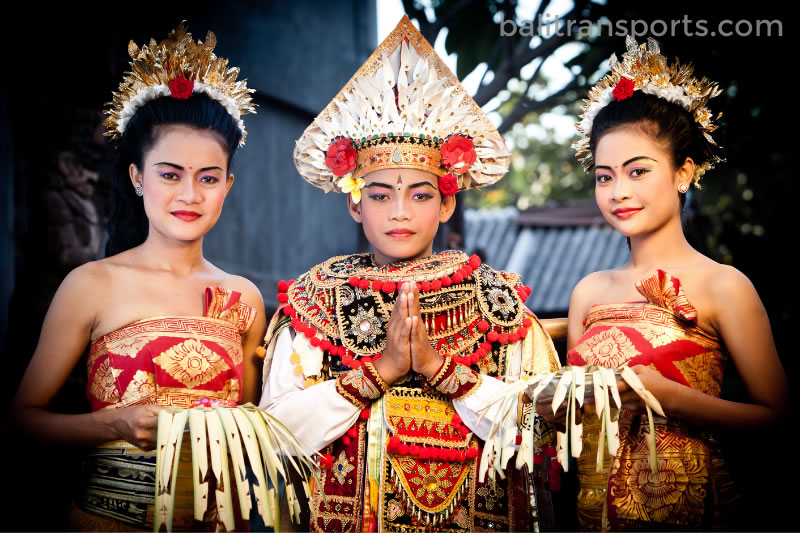
Bali, one of Indonesia’s major tourist attractions, is not only famous for its beautiful beaches, landscape and rice fields but also for its unique cultural tradition: a Balinese Hindu tradition that mainly consists of art and ritual. This religion is rather different from Hinduism as practiced in India because – before Hinduism arrived in Bali – it underwent some radical changes on the island of Java. One important feature of this change being the union between Hinduism (or more specific Shivaism) and Buddhism. This feature is still visible today as, for example, some Buddhist religious writings still play an important role in Balinese Hinduism and the island has a priesthood which contains both Hindus and Buddhists.
1. Beliefs
Hindu Dharma/ Agama Hindu is the name of the religion followed by 90% of the 3,5 million population of Bali. The remaining 10% practice a mixture of faiths: Islam, Catholic, Protestant, Buddhism, and Kong Hu Cu.
The aim of Hindu Dharma is “to reach peace of spirit and harmony in the material life”. In practicing their faith, Hindu communities try to achieve a spiritual balance of worship between Tattwa (philosophy) Susila (Etiquette morals), and Upacara (Ritual). These three areas are subdivided into various tenets.
The Tattwa has five principal beliefs (Panca Crada):
1. Brahman – The belief in the existence of one almighty God head.
2. Atman – The belief in the soul and the spirit.
3. Samsara – The belief in Reincarnation.
4. Karma – Belief in the law of reciprocal actions (one gets back, eventually, what one gives out)
5. Moksha – The belief in the possibility of unity with the dive (Nirwana)
The Susila (etiquette) places emphasis on three major rules for behavior (Tri Kaya Parisudha):
– To think good thoughts.
– To talk honestly.
– To do good deeds.
As well there is important code of Hindu Dharma called Tat Twam Asi “You are as I am” in other words, “to fell the feelings of ones fellow beings’.
Upacara (ritual) is divided into five areas of holy sacrifice (Panca Yadnya):
1. Dewa Yadnya – Holy rituals for the Gods.
2. Pitra Yadnya – Holy ritual for the higher spirits, and rites of death.
3. Rsi Yadnya – Holy rituals for the holy Hindu proph phets (resis).
4. Manusa Yadnya – Rituals for and on behalf of humans (from the baby in womb until marriage)
5. Bhuta Yadnya – Sacrifices for neutralizing the negative influences from the natural and supernatural worlds.
Hinduism is a monotheistic religion with one God head, in Bali called “Ida Sang Hyang Widi”, “Sang Hyang Tunggal or “Sang Hyang Cintya. “Hinduism is often misunderstood as being a faith with many Gods and Goddesses (Dewas and Bhataris). These other gods are merely realization or manifestations of the holy rays from the one God. The word Dewa (Deva) comes from the Sangskrit word Dev, meaning ray.
Bhatara comes from the word Bhatr, meaning protector. The Dewas, or holy manifestation. Of God which appear most often in Balinese religion are called the Tri Murti, or the holy Trinity.
1. Brahma – The Creator
2. Wisnu – The Preserver
3. Ciwa – The Destroyer or returned.
In Bali the Pedanda, (high priest), selected from the Brahmana caste, officiates at large ceremonies. The Pemangku, or village temple priest, looks after the temple and leads the holy rituals included in the Panca Yadnya.
The holy books of the Hindu religion are the Vedas, which original in ancient India. Those which reached Bali are the Catur and the Veda Cirah, which are still used by the priests in carrying out their religious duties. The religion is taught in other forms as well. The most popular of these are the Purana , or morality plays, and the Itihasa, or epic poems, the most well-know being the Ramayana and the Mahabrata. The many theatre forms – the wayang shadow puppet plays, the masked drama, the operas and ballets-are also vehicles of religious teaching.
The beliefs of the Balinese are a living force that pervade the island and reverberate outside it. The island sings of love, the love that spends an hour making an offering of woven palm leaves and flashing flowers, the love that finds the time everyday to think of the “otherworld”, of giving something to the gods, of lighting a stick of incense, of sprinkling holy water, of whispering a mantra as the hands make gentle, sacred movements, of processions incredible in their spelendour, of offerings amazing in their intricacy or surprisingly simple in their humility, of loving work and love bestowed on children a life of love, given freely to everyone in a smile or a wave as you pass by.
On this island there is a link to enlightenment. The Balinese feel themselves to be a blessed people, a feeling, continually reinforced by the wealth of their every – day life and strengthened by the splendour of their religion. It is almost as if the Balinese are living as art continually worshipping their muse. To Nehru, Bali was “the morning of the world”, To the Balinese, Bali is the only “real” world in the world and the sacred mountain Gunung Agung is the “navel of the world,” the umbilical cord form whence the world springs.
2. The Rites of Passage
The Balinese believe that the individual soul is reincarnated into many lifetimes, until through numerous struggles and stages it achieves union with the divine. It is the duty of every Balinese to have children, to provide a vessel for his ancestors is spirits to be reincarnated in. A man does not become a full member of his banjar until he is a father. Children are loved and highly prized in Bali, especially male children, as they carry the blood line of family and also look after the burial and cremation of their parents.
As each lifetime is regarded as a passage from one stage to another, so also there are critical stages during life where an important passage occurs leading toward adulthood. It is the duty of family and friends to help each child through these passages. The rites of passage begin while the baby is still in the womb. A pregnant woman is “sebel”, and is not permitted to enter a Temple. After a safe delivery, the afterbirth becomes the “Kanda Empat”. It finds a spiritual brother in each of the four cardinal directions to accompany the child throughout his wife. There are further rites for the child at 12 days, 42 days, and again at 105 days when the child is for the first time placed, or rather planted, on the ground. Ibu Pertiwi (mother earth) is asked to look after this young offering. Before this ceremony the child is hardly regarded as a human being. At 210 days, (0ne Balinese year), the child is given its name. A Balinese child is never allowed to crawl, as this is regarded as animalistic. He is carried everywhere until he leans to stand and walk.
The passage into puberty is celebrated for both males and females. A girl’s first menses is celebrated, and then the rite of tooth filing follows for girls and boys. This ceremony must be carried out before marriage; often it is incorporated into the marriage ceremony. The canine teeth, which the Balinese regard as animalistic fangs, are filed flat. This represents the evening out of the more extreme aspects of one’s personality as one enter adulthood. After the tooth-filling a father’s duties to his female children are generally regarded as being completed.
For a son, the father must finance and conduct the marriage ceremony, welcoming the bride as a new daughter into the family. The new bride leaves her old ties behind and takes over her new family and their ancestors spirits. Many Balinese marriage are pre-arranged, though young men increasingly prefer to “kidnap” their wives, and mixed caste marriages are more common now.
3. Cremation
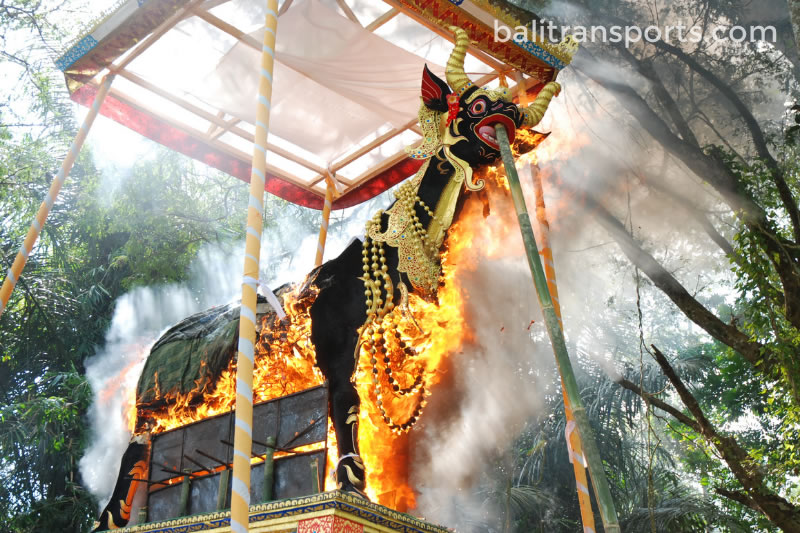
Cremation of the dead (pengabenan, Pelebon) is Perhaps the most important, and often the most colorful, ritual of Balinese religion. A cremation is necessary to liberate the soul of the deceased for the passage into heaven and reincarnation. Due to the immense cost and the complicated preparations necessary, cremations often occur long after the death of the person. Usually, group cremations are held in other to share the expense and the labor involved. Between death and cremation the body is buried in the cemetery, or in the case of a wealthy person whose family can arrange a cremation more quickly, the body lies in state in the family compound. During this time the soul of the deceased is thought to be agitated, longing for release.
An auspicious day for the cremation is chosen by a pedanda, or priest, after consulting the Balinese Calendar. Preparations begin long before the appointed day. Each family builds a large tower of bamboo and paper, extravagantly painted according to the caste and wealth of the deceased, on large bamboo platform. A magnificent, brightly colored, life-size bull is also constructed of bamboo and plaster.
In the morning of cremation relatives and friends of the deceased visit the house to pay their last respect, and are richly entertained and fed by the family. At midday the body is whisked out of the house and carried, with the tower and bull, to the graveyard by members of the dead man’s banjar. This become a loud, noisy, boisterous procession, designed to confuse the soul of the deceased so that it will lose its way and not be able to return to the family compound, where it could cause mischief.
At the cremation ground the body is put into the belly of the bull. A priest officiates at the last rites, and then fires are lit. After the burning, another raucous procession begins, carrying the ashes to the sea or the local river where they are thrown to the wind. This represents the cleansing and disposal of the material body, and is cause for singing and laughing in the care of the soul in the family compound. After sojourn in heaven the soul is believed to be reborn. The status of the re-born soul relates to the person’s karma, or his conduct in previous lives. In general, the Balinese feel that the soul is reborn within the same circle of blood relations. This cycle of dead and re-birth is the cause of the Balinese reference for ancestors. Every Balinese knows that one day he will be an ancestor, whose long passage through the other world must be expedited and cared for it if he is return to his beloved island of Bali.
Your request or reservation is absolutely secure, all personal data is encrypted and will be processed in a secure way through secure email. We take the privacy of your personal data very seriously. Your personal information will only be used to process your booking.