
Monday | 18th May 2026
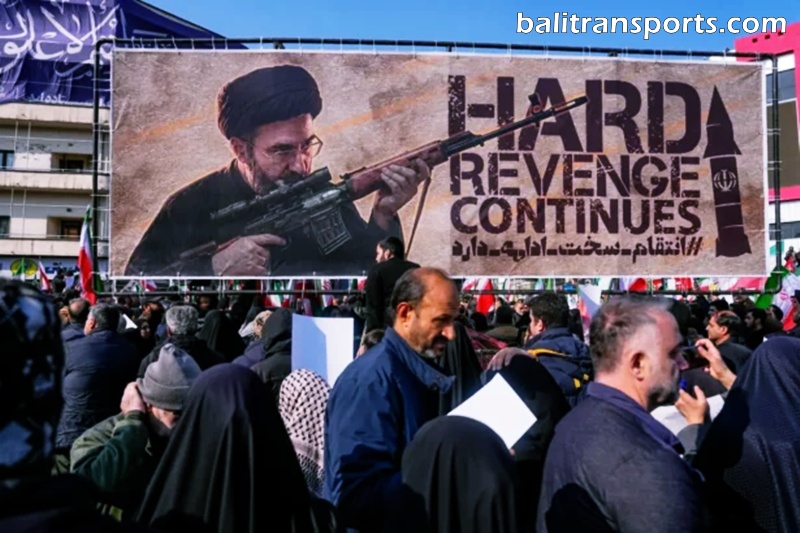
Tehran — As dusk settles over Iran’s sprawling capital and the jagged, snowcapped peaks of the Alborz mountains disappear into the darkness, the city transforms into a stage for nightly displays of defiance and nationalism. Across Tehran, thousands of people have been pouring into the streets for state-organized rallies designed to rally public support against the United States and reinforce the government’s message of resistance at a time of deepening uncertainty.
Near Tajrish Square, one of Tehran’s wealthier northern neighborhoods, loudspeakers blast the familiar chant of “Death to America” across tightly packed crowds waving Iranian flags. The atmosphere resembles a mix of political demonstration and patriotic festival. Vendors line the streets selling hot tea, grilled snacks, and memorabilia — baseball caps stitched with national slogans, patches bearing military symbols, and scarves in the colors of the Iranian flag. Families gather shoulder to shoulder with students, elderly veterans, and young volunteers, all beneath giant portraits of Iran’s leaders and military commanders.
Among the crowd was a young woman named Tiana, wearing glasses decorated in the green, white, and red of the Iranian flag. Her voice strained to rise above the chants echoing through the square.
“I am so ready to sacrifice my life for my country and for my people,” she said passionately, reflecting the mood encouraged by the state’s messaging campaign.
According to Tiana, the determination she feels is shared by many others around her.
“All the people, the whole army, all commanders that we have, they’re ready to sacrifice their lives too, and ready to fight with their whole heart and soul,” she added, brushing aside the latest warnings issued by US President Donald Trump, whose comments have further intensified fears of renewed war.
Trump escalated tensions over the weekend with a post on his Truth Social platform, warning Tehran that time was running out.
“For Iran, the clock is ticking, and they better get moving, fast, or there won’t be anything left of them,” he wrote Sunday, signaling growing frustration as peace negotiations remain stalled and a fragile ceasefire appears increasingly unstable.
The threat has fueled anxiety throughout Iran, where many people now speak openly about the possibility that large-scale hostilities could soon resume.
In the middle of the rally, an elderly man held up a hand-written placard in Farsi and eagerly translated its message.
“Nuclear and missile technology is as important as our borders, so we will protect them,” the sign read.
The man insisted that Iran’s nuclear ambitions are being misunderstood abroad.
“We need nuclear power, clean energy, not a bomb,” he explained, referring to Tehran’s long-standing insistence that its nuclear program is intended for civilian energy purposes rather than weapons development.
“Trump knows we don’t have a bomb, but he is attacking us anyway,” he added bitterly.
As rumors swirl through the capital about possible joint US-Israeli military action, many Iranians appear to have resigned themselves to the idea that the current pause in fighting may only be temporary.
“We know this war isn’t over. We know Trump is not really going to negotiate,” said Fatima, an Iranian woman who said she spent much of her life growing up in London and Dubai before returning to Iran.
“He’s just going to be, like, ‘You do what I tell you or I’m going to kill you,’” she said. “And then he’s going to attack us even if we do as he says.”
The nightly rallies — known locally as “night-gatherings” — have become a routine feature across Iran for nearly three months, beginning shortly after the outbreak of the conflict. What initially appeared to be temporary demonstrations have gradually evolved into a broader nationwide mobilization effort.
In recent days, however, the atmosphere has grown noticeably more militarized.
Across Tehran, public gun-training kiosks have begun appearing in prominent squares and busy intersections, offering civilians basic instruction in handling firearms. The displays suggest authorities are preparing the public psychologically — and perhaps practically — for the possibility of a prolonged conflict.
At one kiosk in Vanak Square, a woman dressed in a black chador stood attentively while a masked man in military fatigues demonstrated how to disassemble and reassemble an AK-47 assault rifle. Nearby, curious onlookers filmed the scene on their phones while children gathered around tables displaying weapons and military gear.
Only a few feet away, a small girl briefly held an unloaded Kalashnikov, raising it toward the sky and pulling the trigger playfully before handing it back to an instructor smiling approvingly beside her.
The message of national readiness is also being amplified aggressively through Iranian state television.
Several broadcasters have incorporated military imagery directly into their programming, with presenters openly handling assault rifles on air as symbols of resistance.
On the state-run Ofogh channel, male anchor Hossein Hosseini appeared live alongside a masked member of the Islamic Revolutionary Guard Corps, or IRGC, who instructed him on firearm use. During the broadcast, Hosseini fired a rifle into the studio ceiling, a dramatic moment seemingly intended to showcase readiness for confrontation.
In another televised segment, Channel-3 presenter Mobina Nasiri addressed viewers while gripping an assault rifle with both hands.
“They sent me a weapon from Vanak Square so that I too, like all of you people, can learn how to use it,” she announced during the program.
Yet beneath the loud displays of nationalism and calls to prepare for conflict, a quieter and more complicated reality exists within Iranian society.
Just a short walk from Tajrish Square, life appeared strikingly different inside a peaceful park near the Cinema Museum of Iran. Couples wandered through tree-lined paths holding hands, students browsed books at an outdoor stall, and families drank tea in relative calm, seemingly detached from the chants echoing nearby.
“No to war,” one young man said softly as he passed.
On a nearby bench, a university professor speaking in hushed English explained that she and her husband longed not for confrontation, but for change and stability. Fearing repercussions, she asked not to be identified.
“We just want to live in a normal country, where our children can have a future,” she whispered.
Others nearby echoed similar sentiments.
“We want peace,” said another young woman, reflecting the wide spectrum of opinion that exists inside Iran — views that are often less visible amid the dominance of official rhetoric.
But as tensions continue to rise and fears of renewed warfare deepen, those quieter voices risk being overshadowed by the increasingly forceful messaging of the Iranian state. In a country bracing for what many believe could be another devastating chapter of conflict, the space for dissent, uncertainty, or even cautious hope appears to be shrinking beneath the growing drumbeat of confrontation.