
Tuesday | September 22, 2026
Over the past month, Iran-backed Houthi forces in Yemen have dramatically expanded their role in the wider Middle East conflict, transforming what had been a largely contained confrontation into a rapidly widening regional crisis.
The Houthis have seized significant stretches of Yemen’s Red Sea coastline, including the strategically important port of Mocha, while also taking positions on islands near the Bab al-Mandeb Strait. At the same time, they have intensified missile and drone attacks against Saudi Arabia, targeting military and energy-related infrastructure and, over the weekend, launching an attack that triggered air-raid warnings in the Saudi capital, Riyadh. Saudi authorities said their air defenses intercepted a ballistic missile, while the Houthis claimed responsibility for a broader series of missile and drone attacks.
The escalation has opened a new and potentially more consequential phase of Yemen’s long-running war.
Rather than concentrating exclusively on the Red Sea coast, Houthi forces are now pressing toward central Yemen, attempting to disrupt the territorial and logistical links that sustain the internationally recognized Yemeni government. Their immediate focus is the mountainous province of Taiz, while heavy fighting is also taking place farther east in the oil-rich province of Marib.
The stakes are considerably higher than the capture of individual towns.
Control of Taiz could allow the Houthis to interfere with one of the most important road networks linking government-held territory in the south with other parts of Yemen. The province also sits between Houthi-controlled territory and areas still held by forces loyal to Yemen’s internationally recognized government.
Yemen analyst Mohammed al-Basha has warned that cutting these routes could threaten a critical transportation and supply connection between government-held areas. The Houthis have encountered significant resistance from local tribes and government-aligned forces, however, meaning the battle for Taiz remains fluid.
The difference between the current fighting and the Houthi advance along the western coast is significant. On the Red Sea front, Houthi forces were able to make rapid gains, with areas around Mocha falling within a relatively short period. In Taiz, by contrast, defenders have so far prevented a similar collapse.
That does not eliminate the danger.
A Houthi encirclement of Taiz would put enormous pressure on government forces and could isolate one of their most important strongholds. Basha has described Taiz and Marib as two critical bastions, arguing that the loss of both would fundamentally alter the military balance.
As of the latest reporting, government forces continue to hold a key road junction connecting Taiz and Aden, an especially important lifeline because the surrounding area is also home to large numbers of internally displaced Yemenis. The renewed fighting is therefore threatening not only military supply routes but also civilian communities already displaced by years of war.
Marib becomes another critical battlefield
Farther east, the battle for Marib is developing into another major test.
Marib is strategically important because of its oil and gas resources, as well as its location at the intersection of several major transportation routes. The Houthis have long sought to gain control of the province, but government-aligned forces have repeatedly prevented them from taking the city and surrounding territory.
That battle has now intensified.
Yemeni government forces have been using artillery and rocket systems against Houthi positions, while Saudi aircraft have increased their strikes in support of government forces. A senior Yemeni commander has claimed that government forces have moved from a defensive posture toward counteroffensive operations.
The internationally recognized government has also said that its forces attacked Houthi fighters and supply lines in the Bab al-Mandeb area and in Bayda province. Military officials said the strikes targeted Houthi positions, personnel and logistical routes, while government authorities released footage they said showed attacks on Houthi equipment.
Those claims have not been independently verified.
The Houthis, meanwhile, have offered their own account of the fighting. Military spokesperson Yahya Saree has claimed that Saudi Arabia carried out hundreds of aircraft and missile strikes across several Yemeni provinces since the latest escalation began. He has repeatedly warned that the Houthi movement will retaliate.
Saudi authorities have not independently confirmed the full scale of the Houthi figures, making it difficult to establish the precise intensity of the air campaign from competing statements.
The conflict is therefore being fought not only on the ground and in the air but also through competing narratives about battlefield losses and military momentum.
The Red Sea is becoming the central strategic prize
The geographic significance of the Houthi advance extends well beyond Yemen.
The group now controls a large portion of western Yemen and has expanded its presence along the Red Sea coast. Its forces are also positioned around the southern end of the Red Sea, close to the Bab al-Mandeb Strait.
That narrow maritime passage is one of the world’s most important shipping chokepoints, linking the Red Sea with the Gulf of Aden and the wider Indian Ocean. Disruption there can affect commercial shipping between Europe and Asia and can force vessels to take substantially longer routes around southern Africa.
The Houthi expansion therefore has consequences far beyond the Yemeni battlefield.
The Group of Seven foreign ministers said Tuesday that the situation in Yemen represents a serious threat to regional stability, global energy security and freedom of navigation in the Red Sea and Bab al-Mandeb. The G7 condemned Houthi attacks against Saudi Arabia and civilian infrastructure and called on the group to end attacks against civilian shipping and return to the political process. The ministers also called on Iran to stop arming and supporting the Houthis.
For Saudi Arabia, the geographical problem is particularly acute.
Riyadh is trying to prevent the Houthis from turning their newly acquired territory into a permanent strategic platform from which they can threaten Saudi territory, energy infrastructure and shipping routes.
Saudi forces have consequently deployed additional fighter aircraft and missile-defense systems while supporting Yemeni government forces on several fronts.
The fighting has already demonstrated the Houthis’ ability to reach deep into Saudi territory. Reuters reported that a drone launched from Yemen was intercepted over Saudi Arabia on September 17, killing a Yemeni resident in the kingdom.
Days later, Saudi authorities reported the interception of a ballistic missile fired toward Riyadh. The incident triggered air-raid alerts in the capital and underscored how the renewed conflict is moving closer to Saudi population centers.
Britain steps in as Washington holds back
The Saudi response has also exposed an important change in the kingdom’s relationship with its traditional Western security partners.
According to regional reporting, Saudi Arabia has sought American assistance, including possible airstrikes against Houthi targets. But Washington has so far avoided committing directly to another major air campaign in Yemen.
That hesitation is significant because the United States has previously played a central role in Saudi Arabia’s security architecture.
Britain, however, has now agreed to provide limited military assistance.
Prime Minister Andy Burnham said Monday that Britain had accepted a Saudi request for defensive air-to-air refueling support for Saudi aircraft. The Royal Air Force is expected to deploy a Voyager tanker for a limited period, reportedly lasting several weeks and subject to review.
Burnham presented the decision primarily as a defensive measure designed to help protect Saudi Arabia and maintain the security of vital regional routes.
The move nevertheless represents a significant development because it places Britain more directly on the side of Saudi Arabia in the latest phase of the Yemen conflict.
Britain has also previously deployed its Sky Sabre air-defense system to Saudi Arabia in response to concerns about missile threats.
For London, the calculation is not limited to the defense of Saudi territory. The security of Red Sea and Gulf shipping routes has direct consequences for global energy markets, trade and inflation.
The latest fighting has already contributed to broader concerns about energy supplies at a time when the Middle East is simultaneously experiencing conflict involving Iran and disruption around the Strait of Hormuz.
Saudi Arabia faces a difficult military calculation
Saudi Arabia now faces a difficult strategic problem.
It must prevent the Houthis from making further territorial gains without becoming trapped in another prolonged ground war in Yemen.
That distinction matters.
The Saudi-led intervention in Yemen beginning in 2015 demonstrated the enormous difficulty of defeating the Houthis militarily. Despite years of airstrikes and extensive military support, the group retained control of much of northern and western Yemen.
The Houthi movement has also demonstrated an ability to survive intense military pressure while developing missiles, drones and other asymmetric capabilities.
Analyst Ibrahim Jalal of the Middle East Institute argues that the Houthis do not need to defeat Saudi Arabia militarily to achieve important strategic objectives. Instead, they can seek to influence how much money, intelligence, logistics, air defense and airpower Riyadh is willing to commit to Yemeni forces fighting on the ground.
That strategy could allow the Houthis to impose costs on Saudi Arabia without attempting to defeat the kingdom’s vastly larger military directly.
The group can also exploit geography.
Rather than becoming trapped in major urban battles, Houthi forces can attempt to surround government positions, sever roads and attack supply lines. Such tactics could gradually weaken government forces without requiring the Houthis to immediately capture major cities.
This is particularly important in Taiz, where the terrain favors defensive operations but also creates opportunities for encirclement.
The question of US involvement
The most closely watched question is now whether the United States will become directly involved.
The New York Times reported that President Donald Trump initially agreed, following a call from Saudi Crown Prince Mohammed bin Salman, to launch US airstrikes against the Houthis, but subsequently changed his position.
Trump has previously indicated that the Houthis have avoided directly confronting the United States while targeting Saudi Arabia.
That distinction could explain Washington’s reluctance to immediately enter the latest Saudi-Houthi confrontation.
The administration is already dealing with the wider consequences of the conflict with Iran, including the security of the Strait of Hormuz and the broader disruption of Middle Eastern energy supplies. A new US air campaign in Yemen could create another military commitment while potentially complicating diplomatic efforts elsewhere.
Some regional analysts have therefore argued that Washington should avoid becoming deeply involved in another Yemen war.
Others have warned that limited American involvement might be necessary if Houthi attacks begin seriously threatening international shipping or key US and allied interests.
The calculation is complicated by the fact that Saudi Arabia is not simply asking for protection from attacks on its territory. Riyadh is also trying to prevent a fundamental change in the military balance inside Yemen.
Iran’s role
Iran’s relationship with the Houthis adds another layer of complexity.
Tehran has provided political and military support to the movement for years, although the precise degree of Iranian operational control over Houthi decision-making remains disputed.
For Iran, however, the Houthis represent an important regional partner capable of applying pressure against Saudi Arabia and threatening maritime routes without requiring Iran to deploy large numbers of its own forces.
The current escalation therefore gives Tehran another potential source of leverage.
The Institute for the Study of War has assessed that the Houthis used the opportunity created by the wider regional conflict to resume their confrontation with Saudi Arabia and seek concessions that could ease their economic pressures.
The G7 has explicitly linked the latest escalation to Iranian support, calling on Tehran to stop arming and supporting the Houthis.
The Houthis, meanwhile, have their own objectives.
Mohammed al-Basha has said the movement wants Saudi compensation for the economic and humanitarian consequences of the long blockade imposed during the Yemen war. Other analysts believe the group’s ambitions extend much further, potentially including the consolidation of territorial control over most or all of Yemen.
Could Aden become the next target?
One of the biggest unanswered questions is whether the Houthi offensive will eventually turn toward Aden.
Aden is the principal base of Yemen’s internationally recognized government and remains a crucial political and logistical center for forces opposed to the Houthis.
If the Houthis were able to threaten Aden while simultaneously controlling much of the western coastline and putting pressure on Taiz and Marib, the government could face an unprecedented strategic crisis.
But an assault on Aden would also carry enormous risks for the Houthis.
The city is heavily contested politically and militarily, and southern Yemen contains powerful local actors with their own interests. A direct attempt to seize Aden could therefore trigger a much broader southern mobilization against the Houthis.
For that reason, the group’s current strategy may be more focused on isolating government-held areas than immediately attempting to capture the city itself.
The objective would be to make the government increasingly dependent on outside assistance while forcing Saudi Arabia to spend more resources defending its ally.
A growing humanitarian disaster
Behind the military calculations, Yemen’s civilian population is once again bearing the consequences.
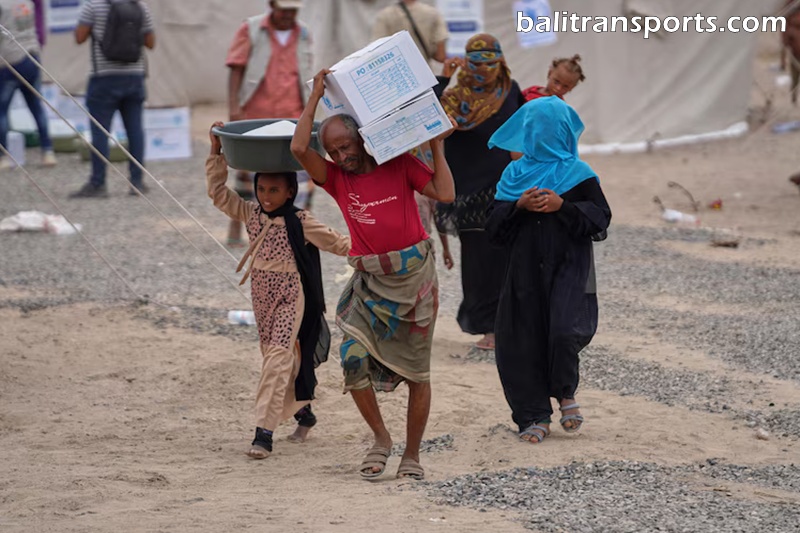
The renewed fighting has already produced a significant displacement crisis. The International Organization for Migration said at least 112,000 people had been displaced inside Yemen as a result of the latest violence by September 18, while nearly 3,000 people had crossed the sea to Djibouti.
That displacement comes after more than a decade of war that has already devastated Yemen’s infrastructure, economy and public services.
Every new territorial offensive therefore risks creating another wave of displacement in communities that have few resources left.
Taiz is especially vulnerable because of its large population and history of siege and conflict. Any attempt to cut its supply routes could quickly affect food, fuel, medicine and humanitarian access.
The Red Sea fighting also creates a second humanitarian risk: disruption to commercial shipping.
If shipping companies begin avoiding the Bab al-Mandeb in large numbers, the resulting increase in transportation costs could affect fuel and food prices across the region and beyond.
The consequences would therefore extend far beyond the battlefield.
Saudi Arabia’s search for partners
Saudi Arabia is not completely without allies.
Turkey has expressed solidarity with Riyadh over attacks on Saudi territory. Foreign Minister Hakan Fidan said Turkey viewed the attacks as serious violations of Saudi sovereignty and indicated that Ankara could help with certain military and technical requirements.
Saudi Arabia has also developed closer defense relationships with other regional and international partners.
But there is a difference between political support and direct military participation.
The latest crisis is testing how far those partnerships actually extend.
Saudi Arabia has invested heavily in its military capabilities and has spent years trying to reduce its dependence on any single external power. Yet the renewed Houthi offensive demonstrates the difficulty of defending the kingdom against a relatively smaller opponent using inexpensive drones, missiles and asymmetric warfare.
The problem becomes even more complicated when the Houthis operate from rugged terrain across a neighboring country with a fragmented political structure.
What happens next?
The immediate battle will likely revolve around three areas: Taiz, Marib and the Red Sea coast.
If government forces can hold the roads around Taiz and prevent a Houthi encirclement, the offensive could lose momentum.
If the Houthis manage to cut those routes while simultaneously increasing pressure around Marib, the government could find itself facing a much more serious strategic crisis.
The situation would become even more dangerous if Houthi forces were able to consolidate their Red Sea gains while maintaining missile and drone attacks against Saudi Arabia.
That would effectively create a military arc stretching from western Yemen toward the strategic waterways and Saudi border.
The Houthis would not need to occupy all of Yemen immediately to benefit from such a position.
They could use control of territory, missile capabilities and access to maritime chokepoints to strengthen their bargaining position in any future negotiations.
That is why the battle for Yemen is increasingly being viewed as part of the wider struggle over the security architecture of the Middle East.
The Houthis’ territorial ambitions, Saudi Arabia’s security concerns, Iran’s regional strategy, Britain’s decision to support Saudi air operations and Washington’s reluctance to enter another Yemen campaign are now converging in the same conflict.
For Saudi Arabia, the central question is whether it can contain the Houthi advance without being drawn into another open-ended war.
For the Houthis, the challenge is whether they can convert their recent battlefield gains into lasting political and economic leverage.
And for the international community, the central concern is whether Yemen once again becomes a major trigger for disruption across the Red Sea, global shipping and energy markets.
The latest escalation has already demonstrated how quickly Yemen’s civil war can spill beyond its borders.
What began as a renewed confrontation between the Houthis and Saudi-backed Yemeni forces is now becoming another interconnected front in the wider Middle East crisis — one that places a crucial international shipping corridor, Saudi energy infrastructure and millions of civilians directly in the path of escalation.