
Monday | 5th October 2026
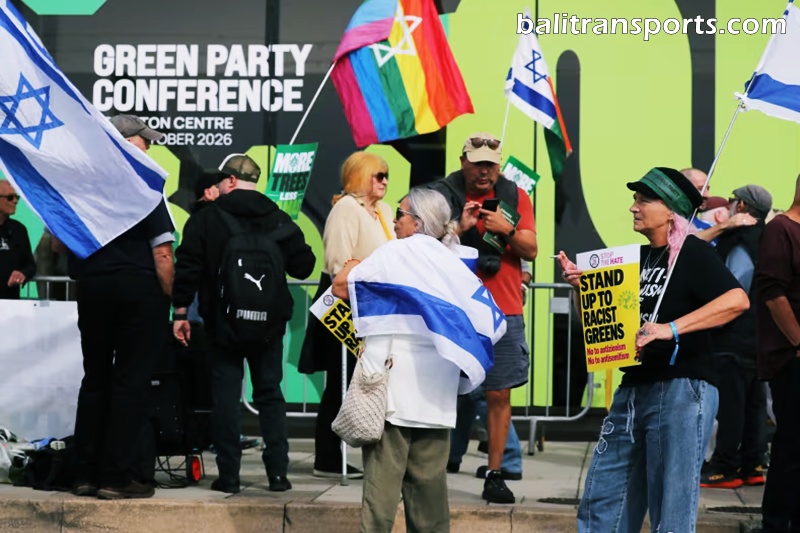
Britain’s Green Party voted on Sunday to classify Zionism as a form of racism, a decision that has triggered sharp criticism from British Jewish organizations, Israeli officials and political opponents, while highlighting the increasingly bitter debate in Britain over Israel, Palestinian rights and the meaning of Zionism.
The motion, approved by party members by 1,022 votes to 813, describes Zionism as “an ethnonationalist political project” and reiterates the Green Party’s demand that Britain’s Labour government halt all arms trade with Israel. The party also reaffirmed its support for Palestinian self-determination and called for the creation of a single democratic state across historic Palestine.
The vote represents a significant escalation in the Green Party’s position on the Israeli-Palestinian conflict. The party received around 6% of the vote in Britain’s 2024 national election and has increasingly sought to distinguish itself from the major political parties over Gaza, arms sales to Israel and Palestinian statehood.
In a statement following the vote, the Greens said the motion also supported “the right to self-determination” and called for a political settlement based on a single democratic state covering historic Palestine. Supporters of the proposal argue that such a framework would provide equal political rights to Palestinians and Jews, while opponents contend that rejecting Jewish national self-determination threatens the legitimacy and security of Israel.
The debate is particularly sensitive because Zionism has different meanings to different groups. Historically, Zionism was the political movement that sought to establish a homeland where Jewish people could exercise national self-determination, ultimately contributing to the creation of the modern State of Israel in 1948. Many Jewish communities continue to understand Zionism primarily as the principle that Jews, like other peoples, have a right to national self-determination.
Critics of Zionism, however, argue that the movement’s historical implementation involved the displacement of Palestinians and the establishment of a state structure that has produced unequal rights and continuing conflict. The disagreement over those competing interpretations has become even more intense since the outbreak of the current Israel-Hamas war.
The Green Party’s decision was opposed by several senior party figures, illustrating the divisions within the organization itself. Party leader Zack Polanski did not participate in the vote. Polanski is also seeking election to Parliament on Thursday in the London constituency previously represented by former Prime Minister Keir Starmer.
The result immediately drew condemnation from British Jewish organizations. The Movement for Progressive Judaism said the Green Party had effectively made antisemitism part of its political policy and described the party as racist.
The organization also argued that the fact that some Jewish people supported the motion did not eliminate concerns about its potential consequences. Critics say that treating Zionism as inherently racist can blur the distinction between criticism of the Israeli government and opposition to Jewish national identity.
Israel’s government responded particularly strongly. Israeli Foreign Minister Gideon Sa’ar said he had decided to bar Polanski from entering Israel, according to the Israeli Foreign Ministry. The ministry also urged other British political parties to condemn the Green Party’s decision.
Israeli officials argued that the Green Party motion amounted to antisemitism under the International Holocaust Remembrance Alliance, or IHRA, definition. They specifically objected to what they described as a denial of the Jewish people’s right to self-determination.
The Israeli Foreign Ministry said the Green Party had adopted an ideological position that went beyond criticism of Israeli government policies. It accused the party of endorsing an agenda that would ultimately eliminate Israel as a Jewish state.
Israel also compared the Green Party’s position with that of Hamas, saying the Greens had adopted an ideology that supports the elimination of Israel through armed struggle. The Israeli government called on other British political parties to distance themselves from the motion and reject what it described as extremist rhetoric.
The Green Party strongly rejects the accusation that opposition to Zionism is inherently antisemitic. Senior party figures have argued that it is possible to oppose Zionism while simultaneously supporting the rights, safety and equality of Jewish people.
Mothin Ali, the party’s deputy leader and a supporter of the motion, said the enormous Palestinian death toll during the war was central to the debate. Speaking to Sky News before the vote, Ali said the motion explicitly defined Zionism as an ethnonationalist movement and linked it to what he described as ethnic cleansing and genocide.
His comments reflect the broader argument made by supporters of the motion: that the term Zionism should be examined through the consequences of policies implemented in Israel and the occupied Palestinian territories rather than being treated simply as a synonym for Jewish identity.
The conflict that forms the backdrop to the dispute began with Hamas’ October 2023 attack on Israel, including the deadly assault on a music festival, in which Israeli civilians and others were killed and hostages were taken. Israel subsequently launched a major military campaign in Gaza aimed at destroying Hamas and securing the release of hostages.
The war has resulted in a massive Palestinian death toll and a humanitarian crisis in Gaza, while Israeli communities have continued to face security concerns and the trauma caused by the Hamas attack and hostage-taking.
The British government has taken increasingly critical positions on some Israeli policies while maintaining that Israel has a right to defend itself. London has described actions by Israeli settlers in the occupied West Bank as amounting to ethnic cleansing, while arguing that questions over whether other Israeli actions constitute genocide are matters for the courts.
Israel rejects allegations that it is carrying out ethnic cleansing or genocide and has repeatedly argued that its military operations are directed against Hamas rather than the Palestinian population.
The Green Party’s vote therefore places it at the center of one of Britain’s most divisive foreign-policy debates. Supporters see the motion as an attempt to challenge what they regard as decades of Palestinian dispossession and unequal treatment. Opponents see it as crossing the line between legitimate criticism of Israel and rejection of the Jewish people’s national rights.
Polanski and other senior Green Party figures have defended their position, saying they will continue to condemn what they describe as “heinous crimes” committed by the government of Israeli Prime Minister Benjamin Netanyahu. At the same time, they insist that supporting Palestinian rights does not require hostility toward Jewish people.
“There is no conflict between supporting the rights of Palestinians and the rights of Jewish people,” the Green Party leadership has argued.
That distinction is likely to remain at the heart of the controversy. The disagreement is not simply over terminology but over competing understandings of national self-determination, the history of Israel and Palestine, the treatment of Palestinians and the boundaries between criticism of a state, opposition to an ideology and antisemitism.
The Green Party’s decision is consequently likely to have implications beyond the party itself. With the war in Gaza continuing to shape political debate in Britain, the vote could intensify pressure on Labour and other parties to clarify their positions on arms exports to Israel, Palestinian statehood and the future political structure of Israel and the Palestinian territories.
For Britain’s Jewish community, meanwhile, the decision has raised concerns that opposition to Zionism could increasingly become a vehicle for hostility toward Jewish identity. For Palestinians and their supporters, the vote represents a growing willingness by parts of British politics to challenge Israel’s policies and the political ideology associated with the country’s establishment.
The controversy illustrates just how difficult it has become for British political parties to navigate the Israel-Palestine issue. Arguments over antisemitism, Palestinian rights, Israeli security and national self-determination have become deeply intertwined, making the Green Party’s decision one of the most contentious political developments in Britain’s continuing debate over the war in Gaza.